Showing posts with label M7B77-WPSV1. Show all posts

Sunday, November 17, 2019

More IR options

I've posted before about the U06R 60 degree flood and the U06R2 90 degree floods.  They do a good job and only about ~$20. You still need a power supply though. Recently I came across some models from Tendelux that come with the power supply. Their model similar to the U06R2 is just ~$10 more. They also seem a bit less visible if that matters. I tried 3 models.

First let's start with the small spot, just $20, and some compare shots from an Amcrest IP4M-1026
Tendelux 80ft IR Illuminator | AI4 No Hot Spot Wide Angle Infrared Light for Security Camera (w/Power Adapter)
Shot with the illuminator off
Shot with the illuminator on. Far tree is about 35 feet from illuminator and 38 feet from the camera.
No bad for so a fill spot.

Next the U06R2 equiv
Tendelux 120ft IR Illuminator | BI8 Compact and Powerful 90° Infrared Light for CCTV Security Camera (w/Power Adapter)
I stuck one down in the picnic area to see what was passing through at night setting off the motion sensor. The camera, HikVision DS-2CD2032-I with 12mm lens, is about 50 feet away so its LEDs do not light much. It is mounted about 10 feet or so to the left of the picnic table.
A shot with the new flood off though there are other floods down the path in the distance.

After shot with the trees trimmed back a bit and the new flood on.
From another camera, a Hikvision DS-2CD2035-I, you can see the BI8 shines clear across the area some 60 feet bright enough for this cam to notice about 80 feet away.
The bright spots near the center of the pic are the eyes of raccoons at the water trough.

Then for a fill in I added another U06R2 I had not installed yet about 20 feet down on the fence to the right. The water trough is about 60 feet from the cam and about 40 feet from the U06R2.
U06R2 added
Notice it blows out the area near it more than the Tendelux does.

Lastly I was hoping the larger model would be good for the driveway but oddly not so much despite being billed as a 200 foot illuminator it is really more of a wider angle flood.
Tendelux 200ft Long Range IR Illuminator | BI18 90° LED Outdoor IR Flood Light for Security Camera (w/Power Adapter)
Here are compares from a Amcrest IP8M-2496 watching the south leg of the driveway.
Shot with no flood on.
With the "200 foot" Tendelux  on.
I swapped in a U06R and it looks much better. The distant tree is about 55 feet away.
Here are same shots from the Microseven M7B77-WPSV1 zoomed to the 22mm max. The building is about 300 feet away.

With the "200 foot" Tendelux  on.
With no flood.
With the U06R on.
When I swapped the "200 foot" Tendelux with the U06R I moved the "200 foot" Tendelux to point south. From the feeder cams (an Escam QD900 and Reolink RLC-422W). The Tendelux  could probably stand to be tilted up a bit.
From the Reolink pointed west and the "200 foot" Tendelux on, pointed south
From the Escam and the "200 foot" Tendelux on, pointed south south west
For compare. Note how far to the side it had lit up. Seems more than the stated 90 degrees.
From the Reolink pointed west and the "200 foot" Tendelux off, pointed south
From the Escam and the "200 foot" Tendelux off, pointed south south west
Note in the above Reolink shots the U06R was on. Here is a shot from the Reolink with it off for compare.


Sunday, August 11, 2019

Doing the math on pixels per inch at a distance for your cam

If you think zoom and enhance is a real thing I have some bad news for you. You can guestimate a pixel that might come between two but that is not really adding detail. It is just making it bigger. Even with some sort of fancy AI like in No Way Out it is just going to convert the image to something like you expect to see. Like seeing faces in the clouds. Just think about it and it should be obvious, pixels can not magically resolve into something the camera did not see. The best you can do is monkey with contrast and brightness and maybe a bit motion fix if you are luck. So you need a minimum of in focus pixels snapped at a high enough shutter to reduce motion blur with enough light and or sensitivity to have the contrast to work with.

Yet I'm still seeing a lot of posts where people are talking up static focus 1080p cams with wide angle for outdoors. Let's do the math on that. There is a simple calculator online to get the width of the area being viewed by a cam with a given view angle. For example let's take my old work horse the Foscam 9800 series that is 720p and 70 deg view angle.

So at 20 feet the view width is 24.4 feet or 293 inches. 720p resolution is actually 1,280 pixels so when we divide the pixels by the view width you get  4.3686 pixels per inch. So a face, about 6 inches wide will be 26 pixels across at 20 feet with this cam. 40 is considered to be the min. So even with the best lens focused for 20 feet this is still not going to cut it.

For convenience I worked up the charts below from my compare sheet. Note these charts assume the camera is focused for the target distance and not the upscaled resolution some cams advertise. Despite claims, outdoor fixed focus cams seem to be focused at around 20 to 30 feet. You might get a "decent 2X screen grab" of targets within +- 10 feet of that. Of course for a large range of  depth you really should look at a camera with auto focus like the Reolink RLC-411WS I've tried. Though it has had the occasional glitch as well. For long distance something adjustable like the Microseven 6-22mm 3MP Manual Zoom Varifocal Len HD 1080P. Or to get an idea of what you might be able to see with a certain model in your location try IPVM calculator which lest you stick a cam on a map of your property to see what the view angle looks like and has simulated day and night shots at the distance you give.


Not those are best case numbers under perfect conditions. While 7 pixels per inch is bare min 14 is the more accepted min. If I change the wanted pixels per inch to 14 the last chart becomes

Note 12 degrees is a fairly extreme telephoto lens in the range of 22mm
70 is standard though up to 90
between 90 and 130 is often called wide angle
180 to 360 are often called 360 view cameras

For a more indepth info look here.

For a visual compare here I am about 33 feet from the cameras.
First an old Foscam FI9804PS 720p and 70 degree view angle

Now compare that with a Reolink RLC-511-5MP with auto focus but zoommed to widest view of about 90 degrees.

We can obviously see a lot more  and it looks clearer. Just for comparison here is the view from a 1080p  M7B77-WPSV1 at max zoom to a view of about 12 degrees located about 190 feet way.

The main diff appears to be the angle .

Now crop the images down to just me and the cart and make them the same size for a recognition compare. Note the sizing is done by the browser. You might interpret a bit more with a smart resize.

The Foscam image cropped
The Reolink image cropped

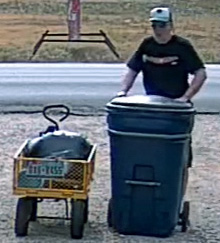
Lastly the Microseven image cropped.
So a 1080p cam with a 12 degree angle and focused for distance yet almost 6 times the distance away would be better for pulling a plate at the gate than the 720p with 70 degree view. Obviously the 5MP at the gate wins though probably by not as much as you would have thought. I should note here too the Foscam was only doing about 1 fps till I ran power out there so I hook up and access point via Ethernet Over Power. I did that so I could stick a Wyzecam V2 out there but that was a bust. Given its 110 degree view you get a shot like this.

First here is the Foscam from the Wyze compare test. I'm a bit further out in this one about 60 feet from the cams. You can see the zoomed Reolink image behind it. Note images were resized to match width of widest image (the Roelink).

Here is the save shot form the Wyzecam V2

And the uncovered Reolink zoomed to its max of 31 degrees horizontal.
Note the glitch in the pic turned out to be a config Blue Iris issue. Inspect sets it to be a generic RTSP and you want to set it as a Reolink.
And lastly a similar shot with the Reolink unzoomed.

In case you are wondering here are some shot with me much closer.
Foscam shot of me at the parcel box
Wyzecam V2 shot of me at the parcel box

One last distance compare back down the drive about 85 feet from the cams. Between the Microseven still zoomed the max.

And an Amcrest 4K IP8M-2496EB with about 112 degree view angle.

For those that think you can just zoom in, here is what you see if you zoom in to match the Microseven.

But there is one more factor to consider, focus. Autofocus can add a lot though when it gets it wrong it can make your cam useless too. Here is a close up shot with the Foscam where I'm just 7 feet away. The cart maybe double that.
Note the plate looks good but the logo on my cap is blurry. I'm too close for the range this cam is set too.
Here is the same shot from the Reolink zoomed out to the max.
Notice both my face and the plate are in focus because the camera has adjusted.
The down side, something flying too close to the lens can leave you looking like this.

Monday, March 26, 2018

Microseven 6-22mm 3MP Manual Zoom Varifocal Len HD 1080P

Microseven 6-22mm 3MP Manual Zoom Varifocal Len HD 1080P SONY 1/2.8" CMOS Built-in Microphone & POE ONVIF Works with Alexa, WiFi IP Camera Outdoor 128GB, Free M7 Cloud &Live Streaming on microseven.tv

Unlike the Reolink 411ws this one has a manual zoom, 6 to 22 mm, and focus which means you set the sweet spot where you want it and it will stay there unlike the Reolink 411ws when it is loses power. Or as it is doing now, just reboots.

Technically the Microseven M7B77-WPSV1 would not focus at its full zoom. I pushed the focus to the max and then backed off the zoom till I got it to focus at a target about 65 feet away. 

Here are the shots for testing recognition at just over 100 feet. First the Reolink 411ws at full zoom looks like this

And Microseven M7B77-WPSV1 also at "full zoom" looks like this.

Right off you can see it is zoomed in tighter and clearer. But the rez is lower 1080p @ 3MP vs 1728p @ 5MP. If you zoom in on the pics though you see the higher optical zoom of the Microseven M7B77-WPSV1 (left) still looks a bit better. 

At about 200 feet the Reolink 411ws looks like

And the Microseven M7B77-WPSV1 like

Zooming in again they compare like this Microseven M7B77-WPSV1 left and Reolink 411ws right

Still neither is all that useful at 200 feet for license plate reading or face recognition.
At 165 feet it is almost usable. Though I'd say my beard looks a LOT longer in this pic than it is.

Night vision is better though


Zoomed in it still looks pretty good.

That building is 370 feet away.
Compare with this shot from the zoomed in Reolink 411ws

But then the Escam QD900 beat the Reolink 411ws in this test
Even with all the grain in the Escam shot might still edge out the others in this one case. Note however the Escam's night vision distance is very limited on its own so without the security light on that building. I should note in the Reolink vs Escam compare there was also an IR flood installed while in the Microseven M7B77-WPSV1 shots above no IR flood was used. For an idea of how well these illuminate here is a wide shot from the Reolink 411ws
Note the time and name are wrong because it has lost its config again.
Here is the same shot from the Microseven M7B77-WPSV1. Note the name and time display are turned off on it.

Paired together I think they give great coverage. If I only could have one I'd probably go with the Reolink 411ws given the fact fully zoomed in you still have a wider field of view while getting almost as good recognition abilities at distance. Note I did not include and zoomed out shots from the Microseven M7B77-WPSV1 because it focusing it can be a bit touchy and since it only goes down to 6 mm it still would not be as wide as a standard 70 degree lens at only 50 degrees. The Reolink 411ws above for comparison is 98 degrees.

One last shot to highlight a minor point the OSD of name and time are small and only have top and bottom as options. So in case that matter here is a shot with OSD turned on.

Generally I leave the camera's OSD (top) on as a backup to what Blue Iris has (at bottom). They often get off especially with DST. The Microseven M7B77-WPSV1 OSD I had not even noticed got turned off i earlier shots it is so hard to see.